Oral Surgery
Wisdom Tooth Extraction Cost in Hyderabad: What Affects the Price?
Understand what affects wisdom tooth extraction cost in Hyderabad, including impaction, imaging, surgical complexity, inclusions, recovery and when removal may be advised.
By The Dental Experts team ·
Wisdom tooth extraction cost: the short answer
The Dental Experts is located in Nanakramguda, Hyderabad, and assesses wisdom teeth that are painful, partly erupted, difficult to clean or found incidentally on an X-ray. There is no responsible single price for every wisdom tooth extraction because an erupted tooth that can be removed simply is different from a deeply impacted tooth requiring surgical access.
The final cost depends on the tooth’s position, depth of impaction, root shape, proximity to nearby nerves or the sinus, whether infection or swelling is present, the imaging and anaesthesia required, and the planned clinical setting. An examination and appropriate dental X-ray are needed before a case-specific estimate can be given.
When comparing quotations, ask whether the figure covers consultation, imaging, local anaesthesia, the extraction or surgical removal itself, sutures when required, prescribed medicines, review visits and management of any unexpected change in the plan. A low headline figure may not describe the complete episode of care.
Not every wisdom tooth needs removal
A wisdom tooth may be monitored when it is healthy, functional, fully erupted, positioned acceptably and can be cleaned. Removal is not automatically necessary simply because the tooth is present.
Extraction may be considered when a wisdom tooth causes repeated gum inflammation, decay that cannot be predictably restored, damage or risk to the tooth in front, cystic change, persistent pain linked to the tooth, or other clinically significant problems.
Symptoms alone do not always show the full cause. Pain at the back of the jaw can also come from gum disease, decay, jaw muscles or another tooth, which is why examination matters before deciding on surgery.
Simple extraction and surgical removal are different
A fully erupted wisdom tooth with accessible roots may sometimes be removed using a conventional extraction technique. The clinician loosens and removes the tooth after local anaesthesia, provided the examination and X-ray support that approach.
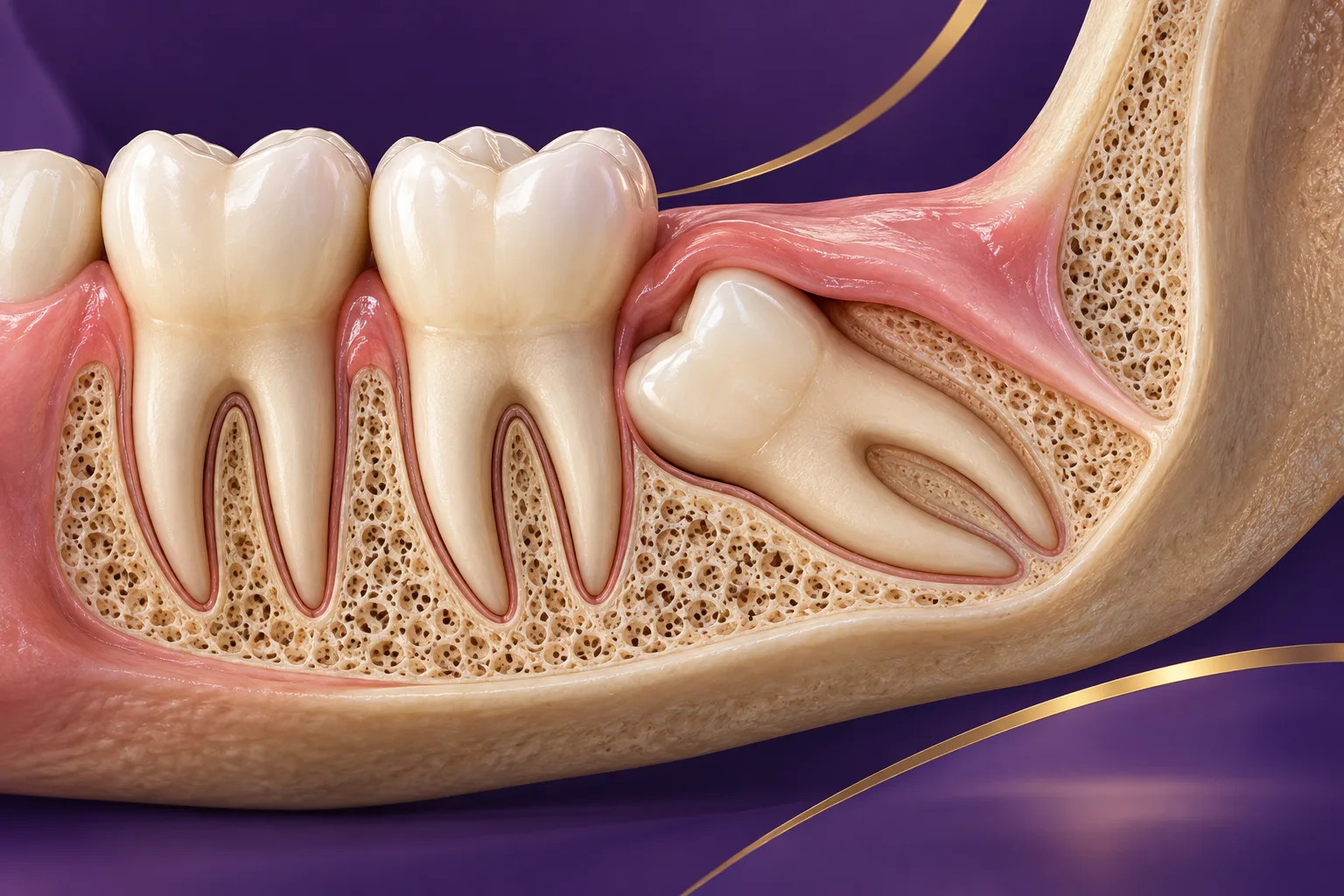
An impacted tooth may be partly or completely covered by gum, bone or both. Surgical removal can involve making an incision, removing a small amount of bone, dividing the tooth into sections, cleaning the site and placing sutures.
The words “wisdom tooth extraction” can therefore refer to procedures with very different time, equipment and skill requirements. The treatment category—not just the number of teeth—is one of the main reasons cost varies.
Factors that affect wisdom tooth extraction cost
Position and impaction: vertical, angled or horizontal teeth may require different access. A tooth covered by bone is generally more complex than one that is fully erupted.
Upper or lower jaw: anatomy differs by site. Lower wisdom teeth may lie near a sensory nerve, while upper teeth can be close to the maxillary sinus. These relationships influence planning and informed consent.
Roots and surrounding structures: curved, divergent or incompletely formed roots can change the technique. The condition of the neighbouring second molar and surrounding bone also matters.
Imaging: a dental X-ray is commonly used. Three-dimensional imaging may be considered when it would materially help assess anatomy or risk; it is not automatically necessary for every case.
Anaesthesia and setting: many extractions are performed with local anaesthesia. Sedation or a hospital-based setting may be considered for selected clinical or patient needs and can change the overall cost.
Additional care: managing active infection, treating the adjacent tooth, prescribed medicines, pathology testing when indicated, sutures and follow-up care may be included or charged separately.
What happens during assessment and treatment planning?
The dentist asks about symptoms, previous episodes of swelling, medicines, allergies and relevant medical conditions. The mouth is examined for eruption, gum inflammation, decay, food trapping, mouth opening and the condition of the tooth in front.
Imaging helps show the wisdom tooth’s position, roots and surrounding anatomy. The clinician can then explain whether monitoring, cleaning around a partly erupted tooth, treatment of another cause or removal is appropriate.
If extraction is recommended, the discussion should cover the proposed technique, anaesthesia, expected recovery, important risks, alternatives and the circumstances in which the plan might change during treatment.
The extraction process
Local anaesthetic is used to numb the treatment area. Patients may feel pressure or movement, but pain during the procedure should be reported so the clinician can reassess anaesthesia. The treatment should not be described as universally painless.
For a surgical extraction, the tooth may be exposed and sectioned to permit controlled removal. The socket is inspected and cleaned, and sutures may be placed depending on the site and technique.
Before leaving, you should receive instructions on controlling bleeding, eating, cleaning the area, medicines and when to seek help. Arrange transport or assistance if sedation is part of the agreed plan.
Benefits and limitations of removal
Removing a problematic wisdom tooth can address repeated infection around the tooth, eliminate a tooth that cannot be predictably restored, or reduce ongoing damage to adjacent tissues when those concerns are confirmed clinically.
Extraction does not guarantee that every type of jaw pain, headache or crowding will improve. If the symptom has another cause, removing the wisdom tooth may not resolve it.
Surgery also has risks. These can include bleeding, infection, dry socket, temporary swelling or restricted mouth opening, injury to a nearby tooth or restoration, sinus-related complications for selected upper teeth, and altered sensation when lower-tooth roots are close to sensory nerves. Individual risk should be discussed before consent.
Recovery and aftercare
Bite on gauze for the time advised and follow the clinic’s written instructions. Some oozing, swelling and soreness can occur after extraction, with the pattern depending on the procedure and the individual.
During the early period, avoid vigorous rinsing, forceful spitting, smoking, alcohol and using a straw, because suction or disturbance can disrupt the clot. Choose soft foods and drink water carefully. Use a cold pack only as instructed and never place ice directly on the skin.
Clean the rest of the mouth gently while avoiding trauma to the socket. After the interval specified by the clinician, gentle rinsing may be advised. Take only medicines that were prescribed or confirmed as suitable for you.
Contact the clinic if bleeding does not settle with pressure, pain or swelling is worsening rather than improving, you develop fever, pus, difficulty swallowing or breathing, persistent numbness, or any symptom that concerns you. Breathing or swallowing difficulty needs urgent medical attention.

What should an itemised quotation include?
Ask whether the estimate covers examination, the relevant X-ray, local anaesthesia, simple or surgical extraction, bone removal or tooth sectioning when required, sutures, consumables and a routine review.
Clarify whether three-dimensional imaging, sedation, medicines, pathology, emergency review, treatment of the neighbouring tooth or hospital charges are separate. These items are not necessary in every case.
If more than one wisdom tooth is being considered, the treatment plan should identify each tooth and whether removal is recommended now, later or not at all. Final cost depends on the clinical assessment and agreed plan.
Frequently asked questions
Is removing a wisdom tooth painful? Local anaesthesia is intended to numb the area, but pressure and movement may be felt. Post-operative soreness varies. No responsible provider can guarantee a painless experience.
Do all impacted wisdom teeth need surgery? No. Some impacted teeth can be monitored when they are not causing disease and the dentist judges observation appropriate. Others require surgical access because of their position.
Can all four wisdom teeth be removed together? This can be considered in selected cases, but the decision depends on each tooth, medical history, anaesthesia plan, recovery needs and overall clinical judgment.
How long does recovery take? Early swelling and discomfort commonly change over several days, while deeper healing takes longer. The expected course differs between a straightforward extraction and complex surgery.
Why might a three-dimensional scan be requested? It may help when conventional imaging does not adequately show the relationship between the tooth and important anatomy. It should be based on clinical need.
Can antibiotics replace extraction? Antibiotics do not correct an impacted position or permanently remove a source of repeated local problems. They are prescribed only when clinically indicated, and definitive management depends on diagnosis.
Planning a wisdom tooth assessment in Nanakramguda
The Dental Experts is physically located in Nanakramguda, Hyderabad. The clinic also welcomes patients travelling from nearby Financial District, Gachibowli, Khajaguda, Kokapet, Narsingi and Manikonda.
Bring previous dental X-rays and a list of medicines if available. During the visit, ask whether removal is necessary, whether the procedure is expected to be simple or surgical, which imaging is needed, what the quotation includes and what recovery support is available.
Because position and complexity vary widely, final wisdom tooth extraction cost can be confirmed only after individual clinical assessment.
Sources and further reading
This article provides general information and does not replace an individual dental examination.
← All articles