Cosmetic Dentistry
Veneers Cost in Hyderabad: Price Factors, Process and Alternatives
Understand what affects veneers cost in Hyderabad, what may be included, who may be suitable, the treatment process, limitations and alternatives.
By The Dental Experts team ·
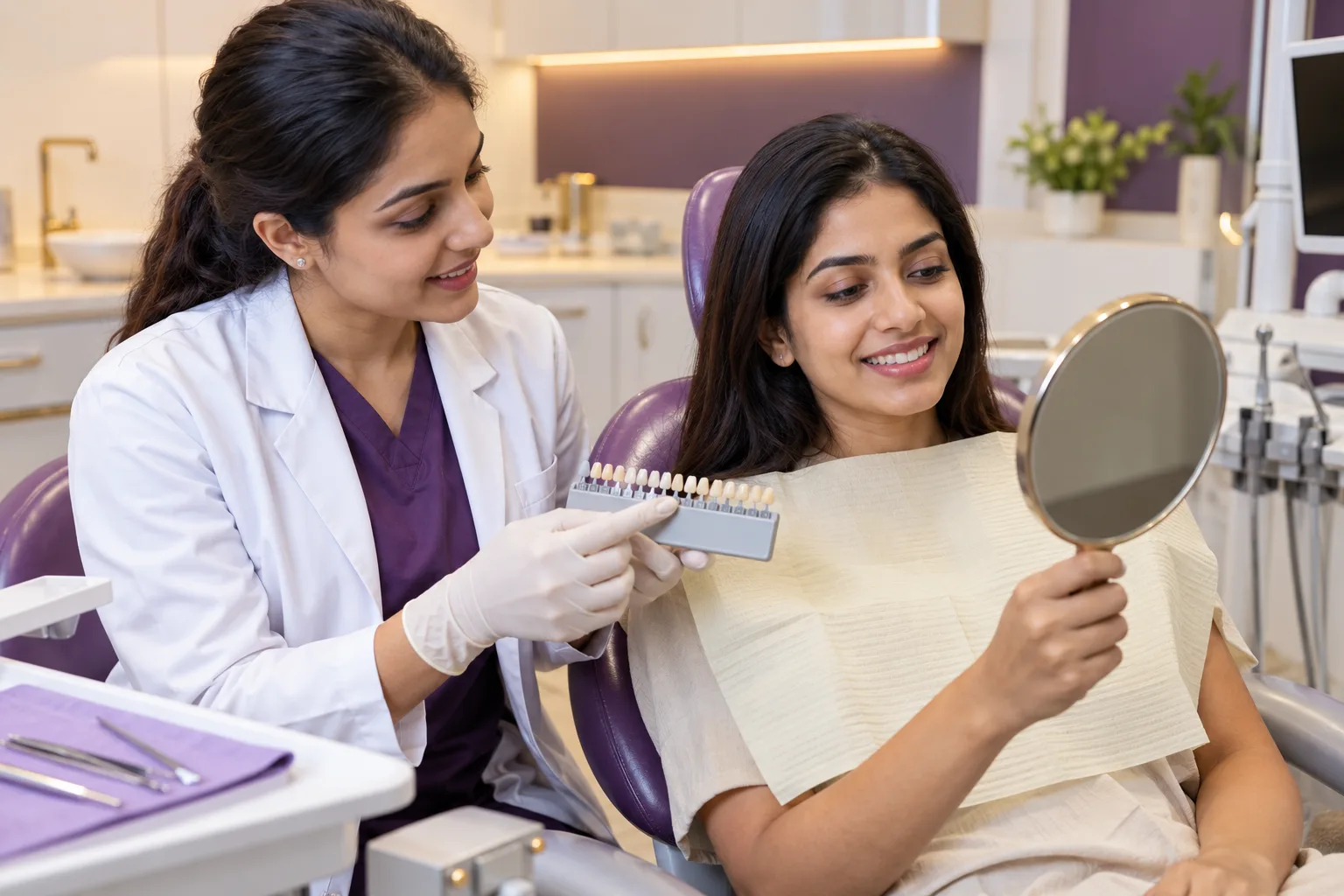
Veneers cost in Hyderabad: the short answer
The Dental Experts is a dental clinic in Nanakramguda, Hyderabad, serving patients from nearby Financial District, Gachibowli, Khajaguda, Kokapet, Narsingi and Manikonda. Dental veneers are thin restorations placed over the visible front surface of selected teeth to change aspects of their shape, colour, length or symmetry.
There is no single responsible veneers price that applies to every smile before an examination. The total cost depends on the veneer material, the number of teeth treated, the amount of planning and preparation required, laboratory work, temporary restorations when needed, bite considerations and whether the teeth or gums need treatment first. Final cost therefore requires a case-by-case clinical assessment.
When comparing quotations, ask for the cost per tooth as well as the estimated total plan. Also confirm whether consultation, photographs or scans, X-rays if required, mock-ups, tooth preparation, temporaries, laboratory charges, fitting, adjustments and review visits are included.
What factors change the cost of dental veneers?
Material is one major factor. Ceramic or porcelain veneers are custom-made outside the mouth and usually involve laboratory design and fabrication. Direct composite veneers are shaped using tooth-coloured resin in the clinic. These options differ in appearance, stain resistance, repairability, preparation requirements and expected maintenance; the least expensive option is not automatically the most suitable one.
The number of teeth matters because a single discoloured or chipped tooth is a different project from changing several front teeth across the smile. Treating multiple teeth also requires careful planning so that proportions, colour and the transition to untreated teeth look coherent rather than artificial.
Complexity can increase when teeth are crowded, rotated, heavily restored, worn, cracked or uneven in position. The dentist must also assess the bite. A veneer placed on a tooth that receives unfavourable biting forces may have a higher risk of chipping or debonding unless the underlying problem is addressed.
Additional items can include diagnostic records, a digital or physical mock-up, temporary veneers, gum treatment, decay management, replacement of defective fillings and a night guard for selected patients who clench or grind. These are not appropriate in every case, so patients should ask which items are necessary and which are optional.
What can veneers help with—and what can they not fix?
Veneers may be considered for selected teeth with persistent discolouration, minor shape irregularities, small gaps, limited chips, worn edges or asymmetry. The goal should be a proportionate result that fits the face, gums and neighbouring teeth rather than simply making every tooth larger or very white.
Veneers do not treat active decay, gum disease or infection. They also do not reliably solve every orthodontic problem. Significant crowding, bite discrepancies or tooth-position concerns may be better managed with braces or clear aligners, either instead of veneers or before cosmetic work.
If colour is the main concern and the tooth structure is otherwise healthy, professional whitening may be a more conservative option. For a small chip or contour change, composite bonding may sometimes be considered. A badly weakened tooth may need a different restoration, such as a crown. The correct choice depends on how much healthy tooth remains and what functional load the tooth carries.
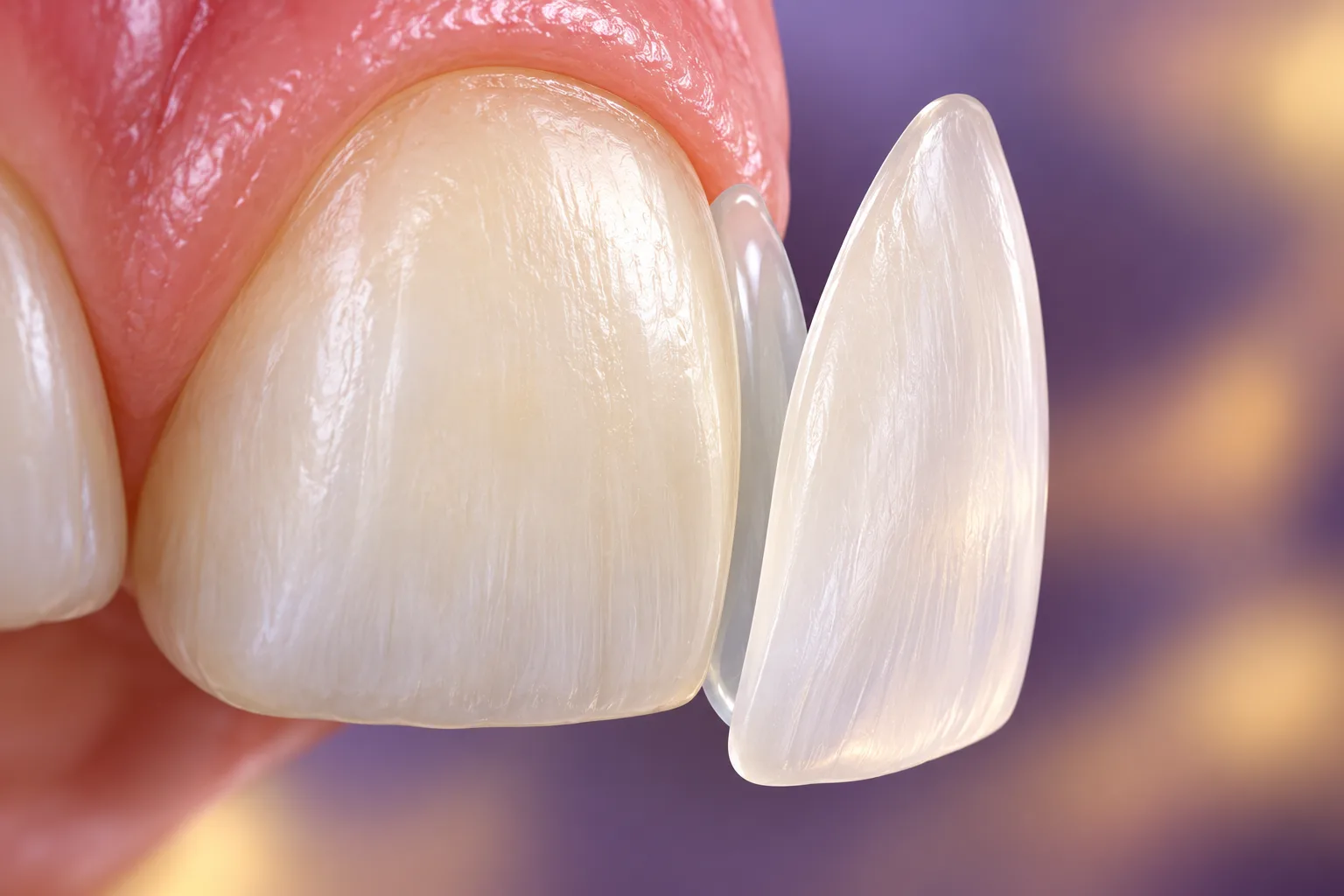
How a veneer fits over the tooth
A veneer covers the visible front surface rather than surrounding the entire tooth like a crown. Some cases require removal of a small amount of enamel to create space and a suitable bonding surface; the extent varies with the tooth position, material and planned design. Because enamel removal cannot simply be reversed, patients should understand the proposed preparation before consenting.
A no-preparation or minimal-preparation approach is not automatically suitable for every smile. Adding material without adequate space can make teeth look bulky or affect the gumline and bite. Conservative treatment means preserving tooth structure while still respecting the biological and functional limits of the case.
What happens during veneer treatment?
Planning begins with a dental and gum examination, discussion of expectations, assessment of the bite and review of existing fillings, cracks or sensitivity. Photographs, scans or impressions may be used to study tooth proportions and communicate the proposed result.
For laboratory-made veneers, the teeth are prepared only as indicated by the plan, records are sent to the laboratory and temporary restorations may be placed when required. At the fitting visit, the dentist checks appearance, margins, contact between teeth and bite before bonding the veneers. Adjustments and review may follow.
Direct composite veneers are generally built and shaped on the teeth using resin rather than fabricated as ceramic shells by a laboratory. The workflow, maintenance and repair considerations differ, which is why a quotation should identify the material rather than use the word “veneers” alone.
Benefits and limitations to consider
A well-planned veneer can alter the visible shape and colour of a tooth while covering less tooth structure than a full crown in appropriate cases. Multiple veneers can also be designed together when symmetry across the smile is the main concern.
However, veneers are restorations—not lifetime natural enamel. They can chip, crack, debond, stain at the margins or eventually need repair or replacement. Gum recession over time can expose a margin, and the colour of existing ceramic cannot be lightened later with ordinary tooth whitening.
Results depend on diagnosis, preparation, bonding conditions, material choice, laboratory quality, bite and home care. Veneers are not a guarantee of a particular appearance, and photographs of another person should be treated as inspiration rather than a promise of an identical result.
Aftercare and maintenance
Brush with a soft-bristled toothbrush and fluoride toothpaste, clean between the teeth and attend reviews at the interval advised for your oral health. Healthy gums matter because inflammation or recession can affect the appearance and margins of cosmetic restorations.
Avoid using veneered teeth to open packages, bite fingernails or crack hard objects. Patients who grind or clench may be advised to use a protective night guard after individual assessment. Seek dental advice if a veneer feels loose, the bite suddenly feels different, an edge chips or persistent sensitivity develops.
Professional cleaning can usually continue around veneers, but the dental team should know which restorations are present so suitable instruments and polishing materials are used.
How to compare veneer quotations fairly
First confirm the material and manufacturer or laboratory route, the number of teeth, and whether the amount is quoted per tooth or for the complete plan. Ask whether diagnostic records, mock-up, preparation, temporary restorations, laboratory charges, bonding, bite adjustment and planned reviews are included.
Ask what happens if gum treatment, decay management, orthodontics or replacement of an old filling is recommended before veneers. Also clarify whether a night guard, repair, remake or future replacement is included, limited by a warranty policy or charged separately.
A very low headline price may exclude important stages, while a higher quotation may cover a broader plan. The useful comparison is the diagnosis, material, scope and follow-up—not the number alone.
Common questions about veneers
Are veneers suitable for every discoloured tooth? No. The cause and depth of discolouration, enamel condition, existing restorations and the desired shade all influence whether whitening, bonding, a veneer or another option is more appropriate.
How many veneers do I need? There is no standard number. Some people need treatment for one tooth; others consider several visible teeth. The smile line, tooth display, colour match and budget should guide the plan.
Do veneers require shaving the teeth? Some cases need enamel preparation and others may need minimal preparation, but “no-prep” is not suitable for everyone. The dentist should explain how much tooth structure is expected to be removed and why.
Can veneers be removed later? A veneer can be replaced, but when enamel has been prepared the tooth will generally continue to need a restoration. This is an important limitation to understand before treatment.
Can I receive an exact veneers cost by phone? A preliminary indication may be possible, but an exact plan depends on the material, tooth count, condition of the teeth and gums, bite and included stages. Final cost requires case-by-case clinical assessment.
Where is The Dental Experts located? The clinic is in Nanakramguda, Hyderabad, and also welcomes patients from the nearby Financial District, Gachibowli, Khajaguda, Kokapet, Narsingi and Manikonda areas.
Sources and further reading
This article provides general information and does not replace an individual dental examination.
← All articles