Orthodontics
Braces Cost in Hyderabad: Types, Price Range & What Affects the Cost?
A practical guide to braces cost in Hyderabad, including metal, ceramic, self-ligating braces and clear aligners, what affects treatment cost, and what to expect during orthodontic treatment.
By The Dental Experts · · Updated
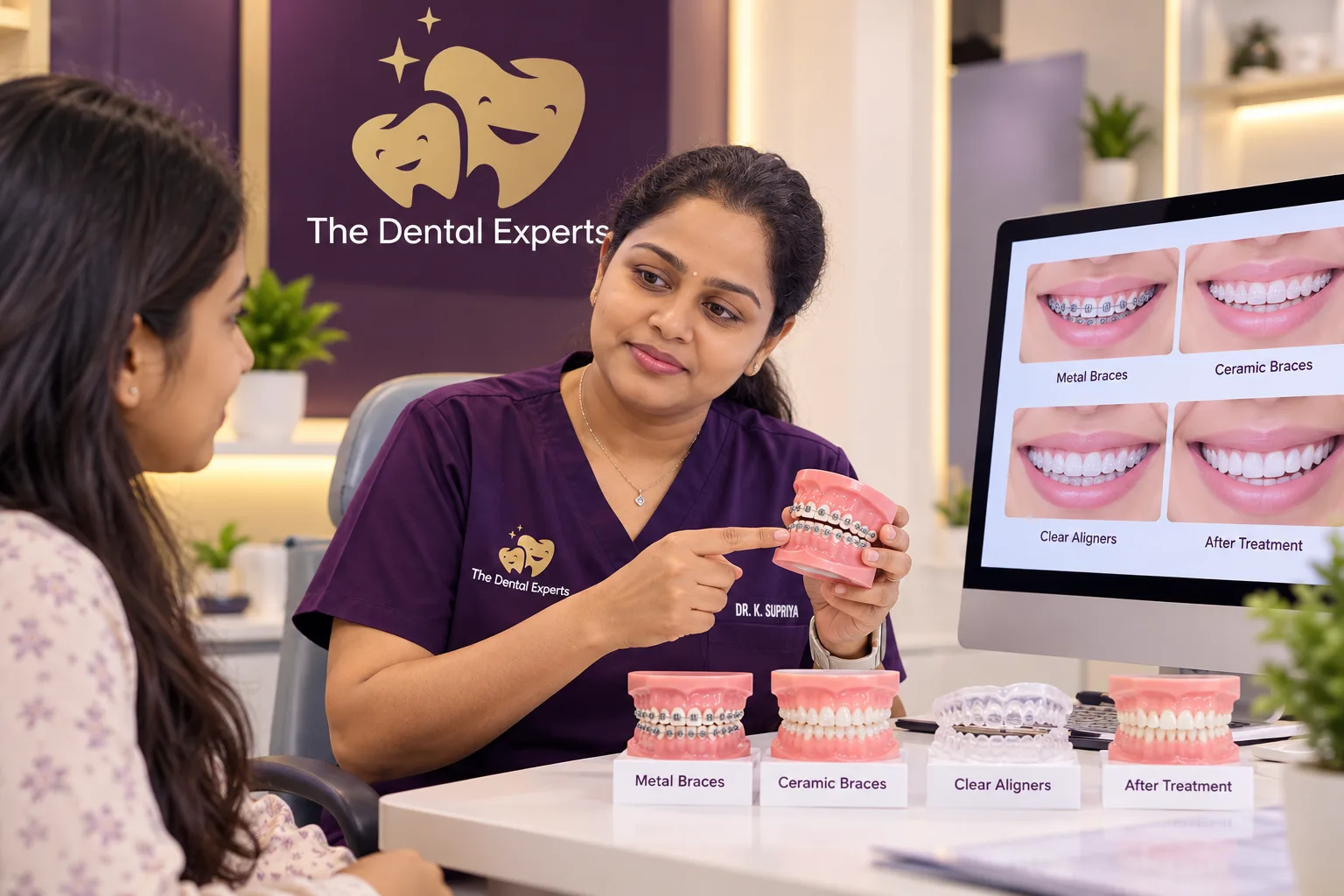
Braces cost in Hyderabad: what should you expect?
If you are considering braces for yourself or your child, one of the first questions is usually: “How much do braces cost in Hyderabad?” At The Dental Experts, Nanakramguda, we see patients from Nanakramguda, Financial District, Khajaguda, Gachibowli and surrounding areas looking for orthodontic treatment for crowded teeth, gaps, bite problems and smile correction.
As a general guide, orthodontic treatment in Hyderabad may fall approximately within these ranges: metal braces ₹35,000–₹55,000; ceramic braces ₹45,000–₹70,000; self-ligating braces ₹50,000–₹80,000; and clear aligners ₹90,000–₹2,00,000+. These are general Hyderabad price ranges and not fixed prices at The Dental Experts.
The final cost can only be estimated after an orthodontic examination because two patients who appear to have similar concerns may require very different treatment plans.
Why does the cost of braces vary?
Braces are not simply a product placed on the teeth. They are part of a treatment process that gradually moves teeth into planned positions.
The overall cost can depend on the severity of crowding or spacing, bite correction required, type of orthodontic appliance, expected treatment duration, number of follow-up appointments and whether additional procedures such as extractions are indicated. More complex orthodontic correction may require a longer treatment period and additional planning.
Metal braces
Traditional metal braces remain one of the most commonly used orthodontic treatments. Small brackets are attached to the teeth and connected using orthodontic wires. At follow-up appointments, the orthodontist monitors tooth movement and makes adjustments according to the treatment plan.
Metal braces are often among the more economical orthodontic options and can be used for a wide range of orthodontic problems.
Ceramic braces
Ceramic braces work on a similar principle to conventional braces but use tooth-coloured or relatively discreet brackets. Patients who would like braces to be less noticeable may prefer this option.
Because of the materials involved, ceramic braces generally cost more than conventional metal braces.
Self-ligating braces
Self-ligating systems use specially designed brackets that hold the orthodontic wire without conventional elastic ties. Whether they offer a meaningful advantage for an individual patient depends on the clinical situation. They should not automatically be considered better than conventional braces.
Your orthodontist can explain whether this type of appliance is appropriate for your treatment.
Clear aligners vs braces
Clear aligners are removable transparent trays that gradually move the teeth according to a digitally planned sequence. They can be an attractive option for patients who prefer a less visible appliance and the convenience of removing the trays while eating and brushing.
However, aligners require good patient compliance and may not be the preferred option for every orthodontic problem. Traditional braces can provide the orthodontist with precise control over tooth movement and remain an effective option for many simple and complex cases.
The choice should therefore be based on the treatment required, rather than appearance or price alone.
What happens during an orthodontic consultation?
Before recommending braces or aligners, the dentist or orthodontist first evaluates the teeth, gums, jaw relationship and bite. Depending on the case, photographs, dental scans or impressions and appropriate X-rays may be required for treatment planning.
At The Dental Experts, the aim of the initial assessment is to understand what needs correction before discussing the most appropriate treatment options. This is also the right time to discuss expected treatment duration, appliance choices, oral-hygiene requirements and estimated costs.
What happens after braces are placed?
Orthodontic treatment requires regular reviews. During these appointments, tooth movement is assessed and the appliance may be adjusted according to the treatment plan.
Good oral hygiene becomes particularly important because food and plaque can accumulate around brackets and wires. Patients should brush carefully around their braces and follow the cleaning instructions provided by their dentist or orthodontist.

How long does braces treatment take?
There is no single treatment duration that applies to everyone. Many orthodontic treatments take approximately 12–24 months, although relatively simple cases may take less time and complex corrections may require longer.
Treatment duration depends on the original tooth positions, bite, type of movement required, biological response and patient cooperation. Missing appointments or repeatedly damaging brackets can also delay treatment.
Do braces require tooth extraction?
Not always. Some patients have enough space to align their teeth without removing permanent teeth.
In other situations—particularly significant crowding or certain bite relationships—extractions may be considered as part of the orthodontic plan. This decision should be made only after proper orthodontic assessment and treatment planning.
Are braces painful?
Patients commonly experience temporary pressure or tenderness after braces are first placed and sometimes after adjustments. This generally settles as the mouth adapts.
Persistent or unusual pain, broken brackets, loose wires or other concerns should be discussed with the treating dentist or orthodontist.
What happens when braces are removed?
Orthodontic treatment does not necessarily finish when the brackets come off. Teeth have a tendency to move after treatment, so retainers are usually an important part of maintaining the corrected tooth positions.
The type of retainer and how long it should be worn depend on the individual case.
Choosing braces in Nanakramguda and Financial District
If you live or work around Nanakramguda, Financial District, Khajaguda or Gachibowli, an orthodontic consultation can help determine whether metal braces, ceramic braces, another fixed appliance or clear aligners are suitable for you.
At The Dental Experts, Nanakramguda, orthodontic treatment is planned after evaluating the patient's teeth, bite and individual treatment requirements. Rather than choosing an appliance purely based on advertised price, it is useful to understand what needs to be corrected, how the treatment will be carried out and what is included in the proposed treatment plan.
A general online price range is useful for budgeting, but it cannot determine the cost of an individual orthodontic treatment. Final treatment recommendations, duration and costs are decided case by case after clinical assessment.
Frequently asked questions
What is the cheapest type of braces in Hyderabad? Conventional metal braces are generally among the lower-cost fixed orthodontic options. Actual treatment cost varies with the individual case.
Are ceramic braces more expensive than metal braces? Generally, yes. Ceramic brackets tend to cost more because of the materials used.
Can adults get braces? Yes. Orthodontic treatment is not restricted to children or teenagers. Suitability depends on factors including dental and gum health.
Are clear aligners better than braces? Neither option is universally better. The appropriate choice depends on the tooth movements required, complexity of the case and patient compliance.
Do I need retainers after braces? Retainers are commonly recommended after active orthodontic treatment to help maintain the corrected tooth positions.
How do I know the exact cost of my braces? An orthodontic examination and treatment plan are needed before an individual cost estimate can be provided.
This article provides general information and does not replace an individual dental examination.
← All articles